
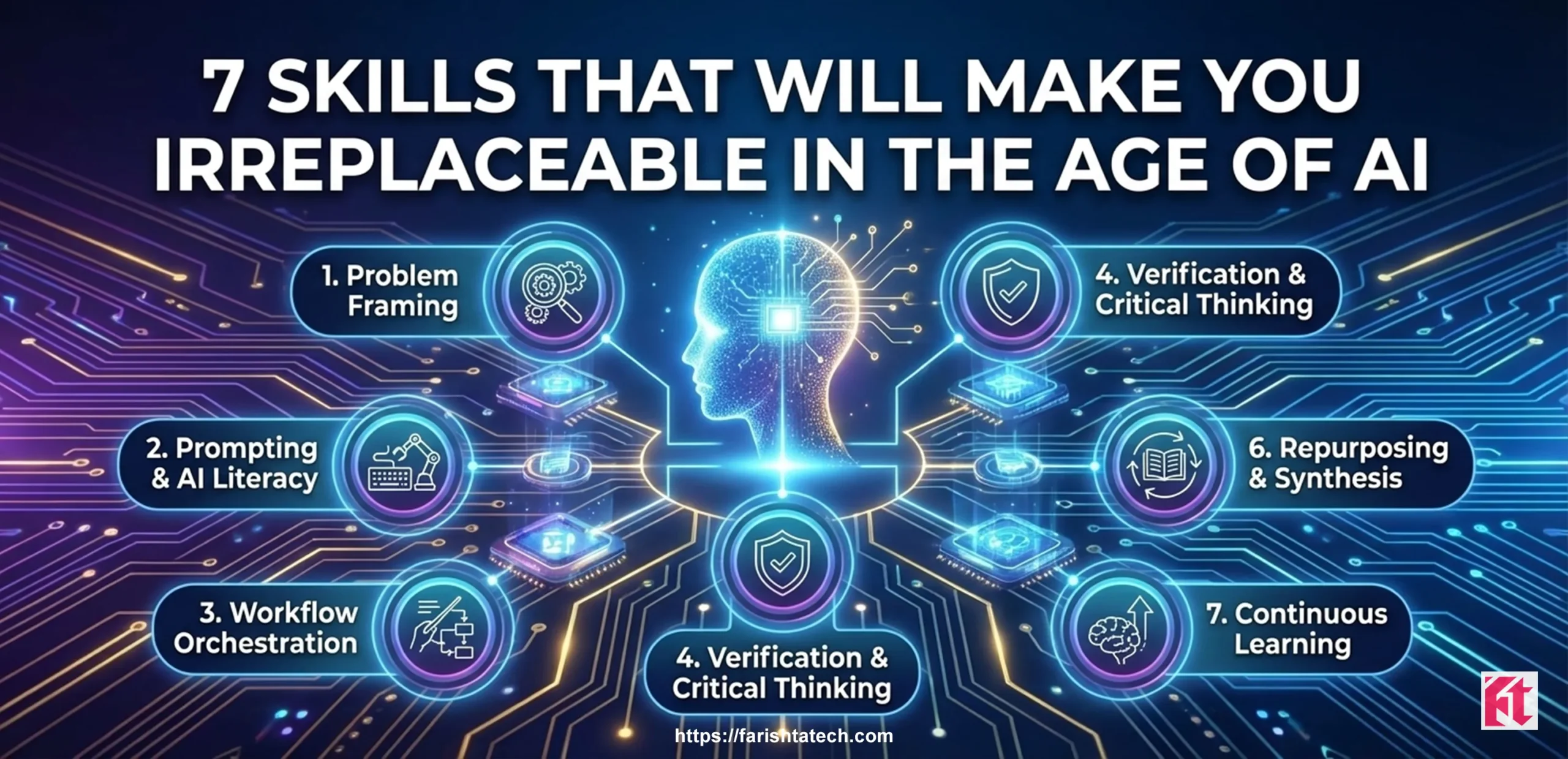
7 Skills That Will Make You Irreplaceable in the Age of AI
Artificial Intelligence is transforming how we work, think, and create. While automation is increasing, human value is evolving—not disappearing. The future belongs to professionals who know how to work with AI, not compete against it.
- Problem Framing
- Prompting & AI Literacy
- Workflow Orchestration
- Verification & Critical Thinking
- Creative Thinking
- Repurposing & Synthesis
- Continuous Learning
AI is no longer a futuristic concept—it is already embedded in business operations, decision-making, and creative workflows. Yet, technology alone does not guarantee success. What truly differentiates professionals today is a powerful combination of human intelligence and AI-enabled skills.
1. Problem Framing
AI can generate answers instantly, but it cannot define the problem for you. Problem framing is the ability to clearly identify what truly needs to be solved.
- Breaking complex challenges into clear objectives
- Identifying root causes instead of symptoms
- Defining constraints, priorities, and success criteria
- Aligning AI tasks with business goals
2. Prompting & AI Literacy
Prompting is the new communication language between humans and machines. AI literacy means understanding how AI behaves, where it excels, and where it fails.
- Writing clear and structured prompts
- Understanding AI limitations and biases
- Choosing the right AI tool for each task
- Refining prompts to improve output quality
3. Workflow Orchestration
The real power of AI lies in how it is embedded into workflows. Workflow orchestration ensures seamless collaboration between humans, AI tools, and software systems.
- Designing AI-assisted processes
- Automating repetitive tasks
- Integrating AI with ERP, CRM, and automation tools
- Optimizing productivity and scalability
4. Verification & Critical Thinking
AI outputs often sound confident—even when incorrect. Critical thinking ensures that AI-generated information is reliable, ethical, and accurate.
- Fact-checking AI responses
- Evaluating logic and consistency
- Applying domain expertise to validate outputs
- Ensuring compliance and data integrity
5. Creative Thinking
Creativity remains a uniquely human advantage. While AI can assist with ideas, humans bring emotional intelligence, originality, and imagination.
- Generating original ideas and innovations
- Blending AI insights with human intuition
- Storytelling and design thinking
- Creating meaningful user experiences
6. Repurposing & Synthesis
AI produces vast amounts of information. Synthesis is the ability to turn that information into insights, strategies, and reusable knowledge.
- Summarizing complex information
- Connecting insights from multiple sources
- Repurposing content across platforms
- Turning data into actionable decisions
7. Continuous Learning
AI evolves rapidly. Continuous learning ensures long-term relevance and adaptability in a constantly changing digital world.
- Learning new tools and technologies
- Staying updated with AI trends
- Reskilling and upskilling continuously
- Embracing change with curiosity
Conclusion: Humans and AI—Stronger Together
AI is not replacing human potential—it is amplifying it. The professionals who thrive will be those who combine strategic thinking, creativity, judgment, and continuous learning with AI capabilities.
Mastering these seven skills positions you as a future-ready professional—someone who leads, innovates, and remains irreplaceable in the age of artificial intelligence.