
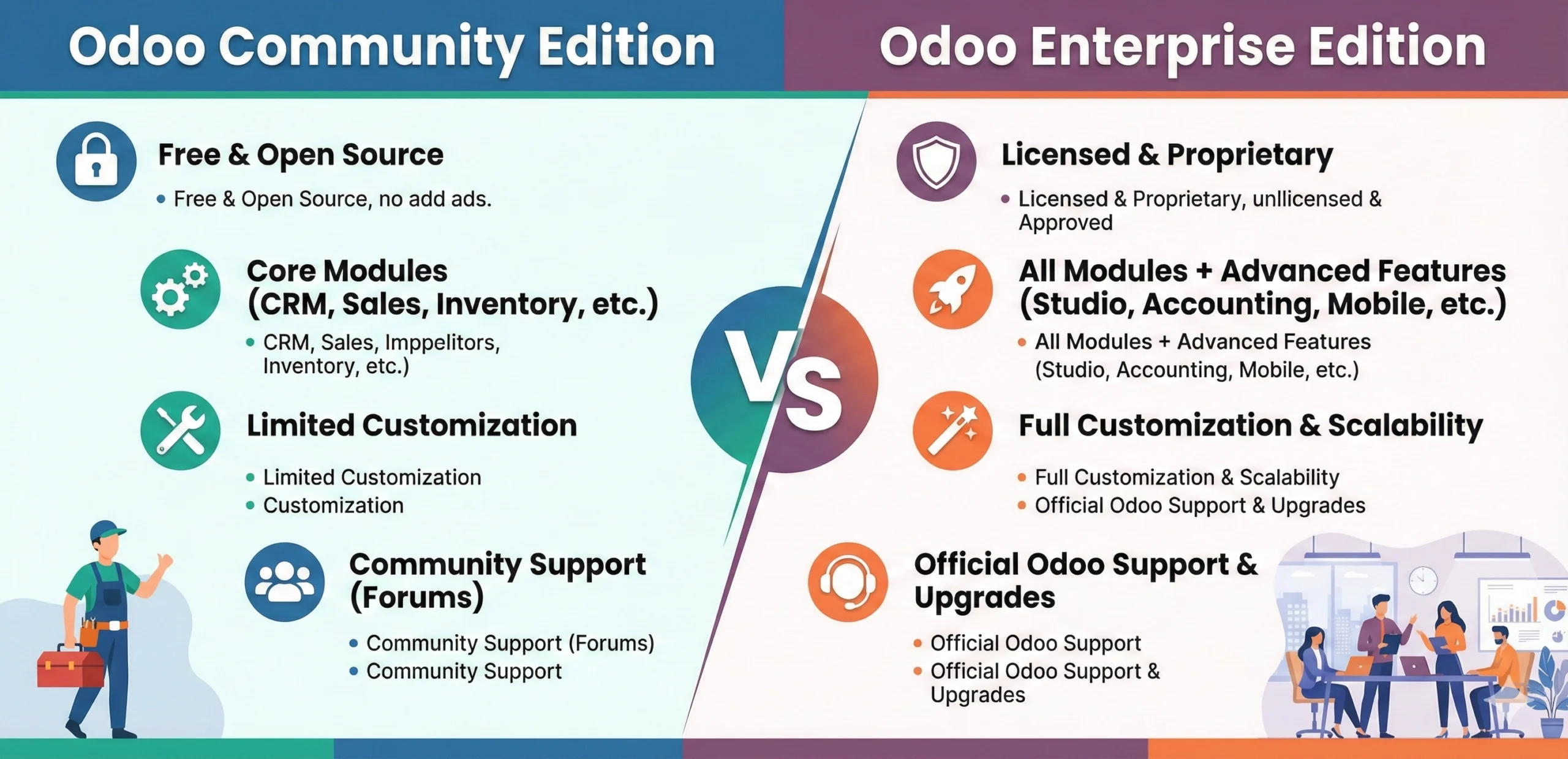
Odoo Community vs Enterprise Edition
A Complete 2025 Guide for Businesses.
An in-depth comparison of Odoo Community and Odoo Enterprise editions — features, pricing, deployment, customization and which edition suits your business in 2025.
2. Odoo Community vs Enterprise — quick summary
3. Licensing & Costs
4. Module-by-module feature comparison
5. Performance & Security
6. Customization & Development
7. Which version is right for your business?
8. Why choose Farishta Tech for Odoo implementation
9. FAQs and Conclusion
What is Odoo?
Odoo is a comprehensive suite of open-source business apps that cover CRM, sales, accounting, inventory, manufacturing, HR, eCommerce and more. Its modular approach allows businesses to start with a few modules and gradually add more as they grow. As an adaptable ERP platform, Odoo is widely used across small businesses and large enterprises due to its flexibility, extensibility and community support.
Odoo Community vs Enterprise — Quick Summary
Both Odoo Community and Odoo Enterprise are built from the same core codebase, but they differ in licensing, bundled features, official support, and convenience. The Community edition is free and open-source, ideal for teams that want to invest in customization. The Enterprise edition is licensed and includes extra modules, mobile support, Odoo Studio and official support from Odoo S.A.
Licensing & Costs
Odoo Community Edition is licensed under LGPLv3 — it is free to use and modify. You will usually pay for hosting, implementation, and development resources.
Odoo Enterprise Edition requires a subscription (typically priced per user per month and per app). The Enterprise subscription grants access to premium modules, mobile apps, official security updates and direct support from Odoo.
Module-by-Module Feature Comparison
The table below highlights the practical differences between Community and Enterprise across major business domains.
| Area | Odoo Community | Odoo Enterprise |
|---|---|---|
| License | Open-source (LGPLv3) — free to use and modify. | Commercial subscription — paid, with official updates and support. |
| Accounting | Basic invoicing and bills; limited advanced accounting features. | Full accounting suite: bank reconciliation, assets, consolidation, audit-ready reports, multi-currency and legal localizations. |
| Inventory & Warehouse | Core stock management and simple routes. | Advanced warehouse operations, barcodes, multi-warehouse, batch/wave picking and forecasting. |
| Manufacturing (MRP) | Basic BOM and work orders. | MRP II capabilities, quality control, PLM, maintenance and operator tablet views. |
| Point of Sale (POS) | Basic POS features suitable for simple retail. | Fully featured POS with offline mode, restaurant features, IoT and loyalty programs. |
| Website & eCommerce | Site builder and basic eCommerce functionality. | Advanced website builder, A/B testing, multi-site support, integrated payment acquirers and live chat. |
| Human Resources | Employees, leaves, basic attendance and expenses. | Payroll integrations, appraisals, recruitment automations, employee portal and engagement tools. |
| Studio & Customization | Requires developer changes; full access to source code for custom modules. | Odoo Studio for no-code customization: drag & drop forms, custom fields and automation without direct code. |
| Support & Updates | Community-driven support and community module updates. | Official support channels, fast security patches and scheduled upgrades from Odoo. |
| Mobile Access | No official mobile app; relies on web responsive UI. | Official mobile apps for iOS and Android with optimized experiences. |
| Scalability & Performance | Scales well with proper hosting and optimization but requires more hands-on tuning. | Performance optimizations and support provided; recommended for high-traffic or multi-branch environments. |
Practical examples
For a small trading company processing occasional invoices and a handful of SKUs, the Community edition is often sufficient. For a multi-site manufacturer with barcode scanning, advanced accounting and large transaction volumes, Enterprise is usually the better choice.
Performance & Security
Security and performance depend on hosting choices, database maintenance and architecture. Enterprise users benefit from faster official security updates and recommended performance settings, while Community users rely on community patches and partner-provided hardening.
Customization & Development
Both editions are highly customizable. Community edition gives full source access and is ideal for teams with Python/Odoo developers. Enterprise reduces the need for code with Odoo Studio and additional built-in modules — helpful for customers who prefer configuration over custom development.
When to prefer Community
- You want to avoid per-user licensing costs.
- Your business requires heavy customization and has an in-house development team or trusted partner.
- You prefer total control over code and hosting.
When to prefer Enterprise
- You need advanced modules (full accounting, MRP II, POS features) out-of-the-box.
- You want official support and scheduled upgrade paths.
- You need mobile apps, Odoo Studio or additional convenience features.
Which Version is Right for Your Business?
Choosing the right edition depends on business size, long-term roadmap, available technical skills and budget. Use the guide below to decide:
- Budget-sensitive & technical team: Community
- Need rapid deployment & support: Enterprise
- Complex accounting & compliance: Enterprise
- Unique business workflows requiring custom modules: Community (or Community with Enterprise modules later)
Why Choose Farishta Tech for Odoo Implementation
Farishta Tech specializes in both Odoo Community and Odoo Enterprise implementations. We provide end-to-end services: requirement analysis, implementation, module development, integration, hosting, training and long-term support. Our team helps you choose the correct edition and deploy a scalable, secure solution tailored to your business.
Pricing Considerations
While Community may seem cheaper initially, consider total cost of ownership (TCO): expenses for development, maintenance, server hosting, and future upgrades. Enterprise subscriptions add license costs but reduce time-to-production with prebuilt modules and official support.
Migration & Future Growth
It is possible to start with Odoo Community and migrate to Enterprise later. A migration plan should include code review, database migration, module compatibility checks and QA testing. Farishta Tech can help build a migration path with minimal downtime.
Frequently Asked Questions (FAQ)
Is Odoo Community truly free?
Yes — the Community edition is open-source and free to use. You still incur costs for hosting, customization and professional services.
Can Community handle large businesses?
Yes. With proper architecture, optimization and the right partner, Community can be tuned to handle large-scale deployments. The choice often depends on the exact modules and transaction volumes required.
Can I migrate from Community to Enterprise?
Yes. Migration is supported but requires planning to ensure module compatibility, data integrity and minimal disruption.
Conclusion
Both Odoo Community and Odoo Enterprise are powerful solutions. Community is perfect for businesses that prioritize cost-effectiveness and deep customization. Enterprise is ideal for organizations that want a polished set of features with official support and easier configuration tools.
At Farishta Tech, we help businesses identify the best edition for their needs and deliver implementations that scale. Whether you start with Community or Enterprise, your ERP can grow with your company.
Our Client’s Say
EXCELLENTTrustindex verifies that the original source of the review is Google. We installed Farishta Tech's POS system in our busy family restaurant three months ago, and the difference has been incredible. Gone are the days of order errors and manual inventory headaches. This system is a game-changer for several reasons- Blazing Fast & Reliable, Eliminated Order Errors, Smart Inventory Management, Excellent Customer Support. We are particularly impressed with the detailed sales reports, which help us understand our best-selling dishes and most profitable times of day. If you run a restaurant, cafe, or any food service business, do not hesitate. This POS system will streamline your operations, improve customer satisfaction, and boost your bottom line. A fantastic investment! Thank you, Farishta Tech, for providing such a robust and user-friendly solution!Posted onTrustindex verifies that the original source of the review is Google. We engaged FarishtaTech for a complete digital overhaul, and the experience has been nothing short of outstanding. Our project involved developing a custom software application and revamping our website. From the very first meeting, their team was insightful, asking the right questions to fully understand our business goals. The project was executed flawlessly—they maintained transparent communication throughout, met all critical deadlines, and delivered a product that was even better than we had envisioned. Exceptional End-to-End Tech Solutions - A Truly Reliable Partner!Posted onTrustindex verifies that the original source of the review is Google. I recently worked with FarishtaTech for our company's website redesign and digital marketing needs, and I couldn't be more impressed with their services! From our initial consultation to project completion, their team demonstrated exceptional professionalism and expertise. -- Highly Recommended - Farishta Tech Exceeded All Expectations!Verified by TrustindexTrustindex verified badge is the Universal Symbol of Trust. Only the greatest companies can get the verified badge who has a review score above 4.5, based on customer reviews over the past 12 months. Read more